
Parallel Worlds – Which one are you living in?
Open Forum - hybrid in Hamburg - 1st of February 2026 🙏
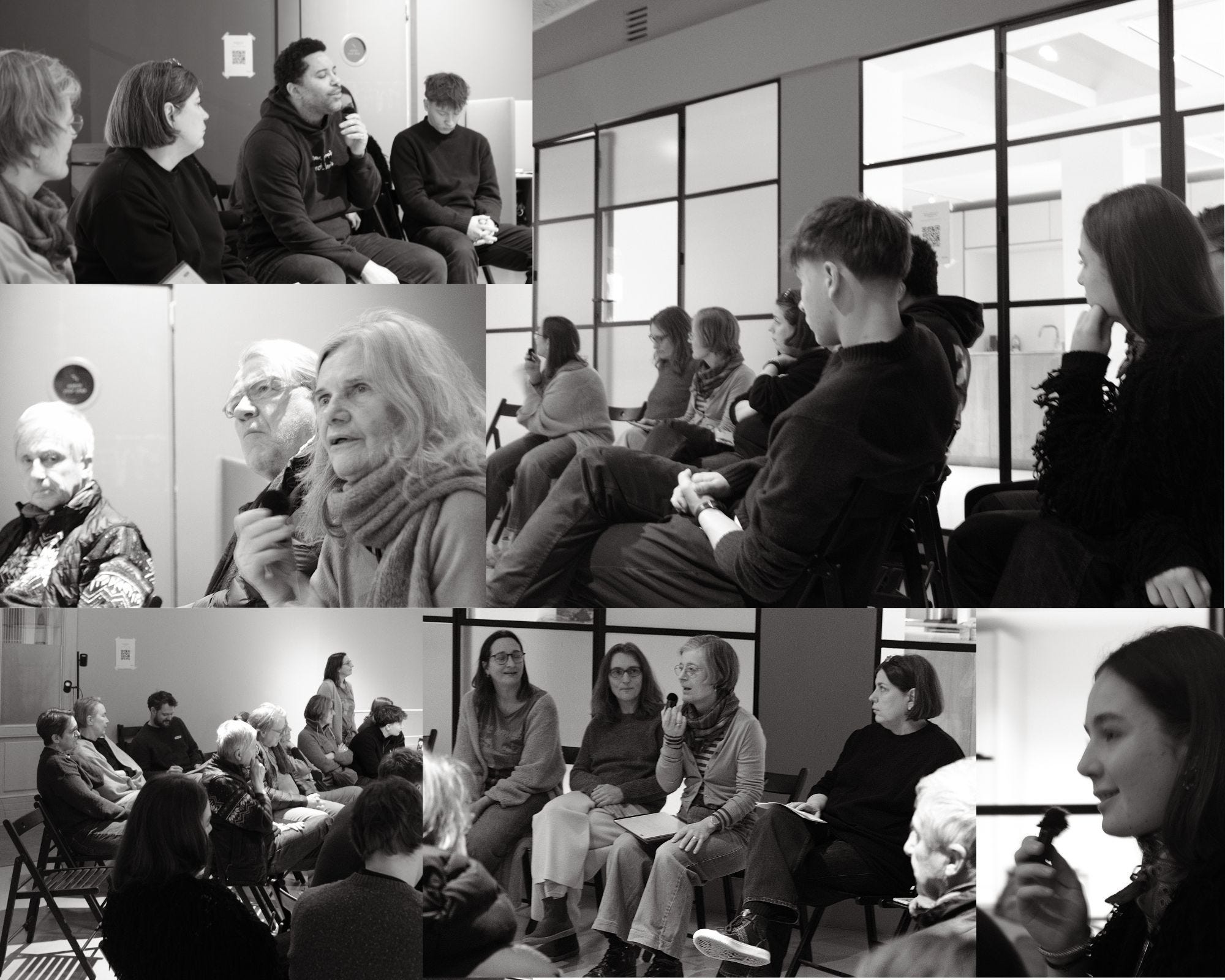
On February 1, 2026, a hybrid Worldwork Journalism Open Forum took place at Eeden in Hamburg and online, gathering around 40 participants (20 on site, 20 online) from Germany, Denmark, the Netherlands, the UK, Italy, Kenya, Spain, Singapore, Lithuania, Ukraine, Poland, Russia, Thailand, Vietnam and beyond.
Worldwork Journalism is a social innovation and a journalistic experiment. It intervenes in polarised public discourse by bringing lived experience and facilitated dialogue into writing across borders, roles and ranks.
Theme of the evening: Parallel Worlds – In which one do you live? What makes meeting each other easy, and what makes it difficult?
Foto credits : Hans Van Langen
Before anyone spoke, the worlds were already in the room.
Not visible.
But present.
In accents. In silences. In the way people chose their first words.
Parallel worlds do not announce themselves.
They sit next to each other.
Scored in Seconds
Ausra told a story from years ago, working as a waitress in Israel. Later in her writing, she turned it into satire.
Lithuania.
Ukraine? –5 points.
EU? +5 points.
Jewish?
No. –50 points.
Game over.
Makes one laugh. Because we recognise it.
How quickly we score one another.
How instinctively we place, categorise, and measure worth.
Parallel worlds can be created in seconds.
Ariane, a German living in Denmark, described another version of this quiet scoring.
“They praise my Germaness in terms of structure, my planning, my reliability,” she said.
“Which is good… and limiting.”
To be appreciated — and confined at the same time.
Yuliya, who moved to Germany from Ukraine, spoke about moving daily between realities.
“There: I’m valued for my professionalism and ideas.
Here: I’m assessed by my age, accent and documents.”
Then she reduced it to one line:
“I’m visible – I’m invisible.”
Not a complaint. A diagnosis.
Who Is Allowed In?
Christoph spoke of white spaces.
Of being the only Black person in a room.
Of constantly navigating invisible power.
Daisy, listening from Nairobi, felt something tighten.
A space speaking about Black and Whiteness — and yet only one person identifying as Black among a group of white voices.
Inside her, a sentence rose:
“Let me in.”
It was not shouted.
It was offered.
“I want more of my people and your people to mingle — to understand one another beyond race.”
And then, just as quietly: “Thank you for trying.”
Longing and gratitude.
Edge and generosity. Generosity from Daisy.
Philipa, as part of the LGBTQ+ community, added another layer.
“I have the privilege of being able to hide who I am…
On the other hand, why am I in this position ?”
Safety can also be erasure.
Parallel worlds are not always imposed from outside.
Sometimes they are strategies for survival.
Generational worlds
An 18-year-old woman asked:
Why do older generations decide on political realities that will shape our lives?
The question did not explode. It settled.
Generation revealed itself as another parallel world.
Time itself divides experience.
War. Climate. Systems.
Decisions whose consequences stretch beyond the lifespan of those who make them.
Later, a middle-aged woman spoke.
“I’m like a blind woman struggling to find my path in the dark, yet there are more blind young ladies right behind me.”
She had believed that by midlife, stability would arrive.
Instead, she finds herself improvising.
“Most of the time I have to fake it to look ‘good example.’”
Something shifted for her that evening.
Not certainty — but honesty.
She decided to mentor younger women differently. Not with perfection. With truth.
Time does not guarantee clarity.
It only deepens responsibility.
The Worlds Inside One Body
Violet from Singapore described another tension.
“My natural state is to be in the dreaming level.
But the country I live in requires us to be productive, efficient and results-driven.”
If she stays in consensus reality, she loses herself.
If she speaks from dreaming, she is looked at “like an alien.”
Parallel worlds can exist within one nervous system.
Listening to all of this, something stirred in me.
I remembered divorcing with three small children. No family close.
Neighbours bringing their children to school, unaware how much it would have meant to take two of mine along when the third was ill.
I remember the exhaustion. Anxiety.
The slow fading of invitations. The darkness at night.
The pride that made it hard to ask for help.
Was it the outer judgment I feared? Or an inner guilt?
Or the burden of having chosen this path.
It does not matter. I fought my lonely inner war.
And War Entered the Room
Maria, a Ukrainian woman, spoke.
They work with children in Kherson during wartime. These days.
They described holding stability where there is none.
Showing up. Again and again.
Missiles.
Cold.
Blackouts.
For a moment, something tightened.
It felt as if this reality should silence everything.
What does identity mean under bombardment?
What is midlife confusion compared to war?
The comparison appeared. And dissolved.
Because something else became visible: Pain can not compete.
And when Lynn spoke, she brought another geography into the room.
Myanmar.
A war less present in European conversations.
Villages burned. Airstrikes. Displacement.
Not closer.
Not louder.
Just further from our daily field of attention.
The map widened.
The war experience did not erase the Black experience in white spaces.
It did not silence the LGBTQ+ experience.
It did not invalidate the blind-in-midlife mother.
It did not cancel the dreaming body in a productivity system.
Parallel worlds are not equal in weight.
And yet they coexist.
Daring to Not Know
One participant later wrote:
“Daring to be unaware as a step towards more awareness.”
It sounded paradoxical.
It felt true.
Perhaps the problem is not that we live in parallel worlds. Perhaps the problem is that we so often demand sameness before we allow encounter.
At the end of the evening, someone wrote:
“I feel lighter and heavier at the same time.”
Lighter — because she was not alone.
Heavier — because once something becomes visible, responsibility begins.
The walls did not fall that night.
But they moved.
The courage was not in solving.
It was not in agreeing.
It was in staying.
Remaining present when worlds touched —
without collapsing them into one,
and without turning away.
Maybe real meeting begins exactly there.
Voices from Participants
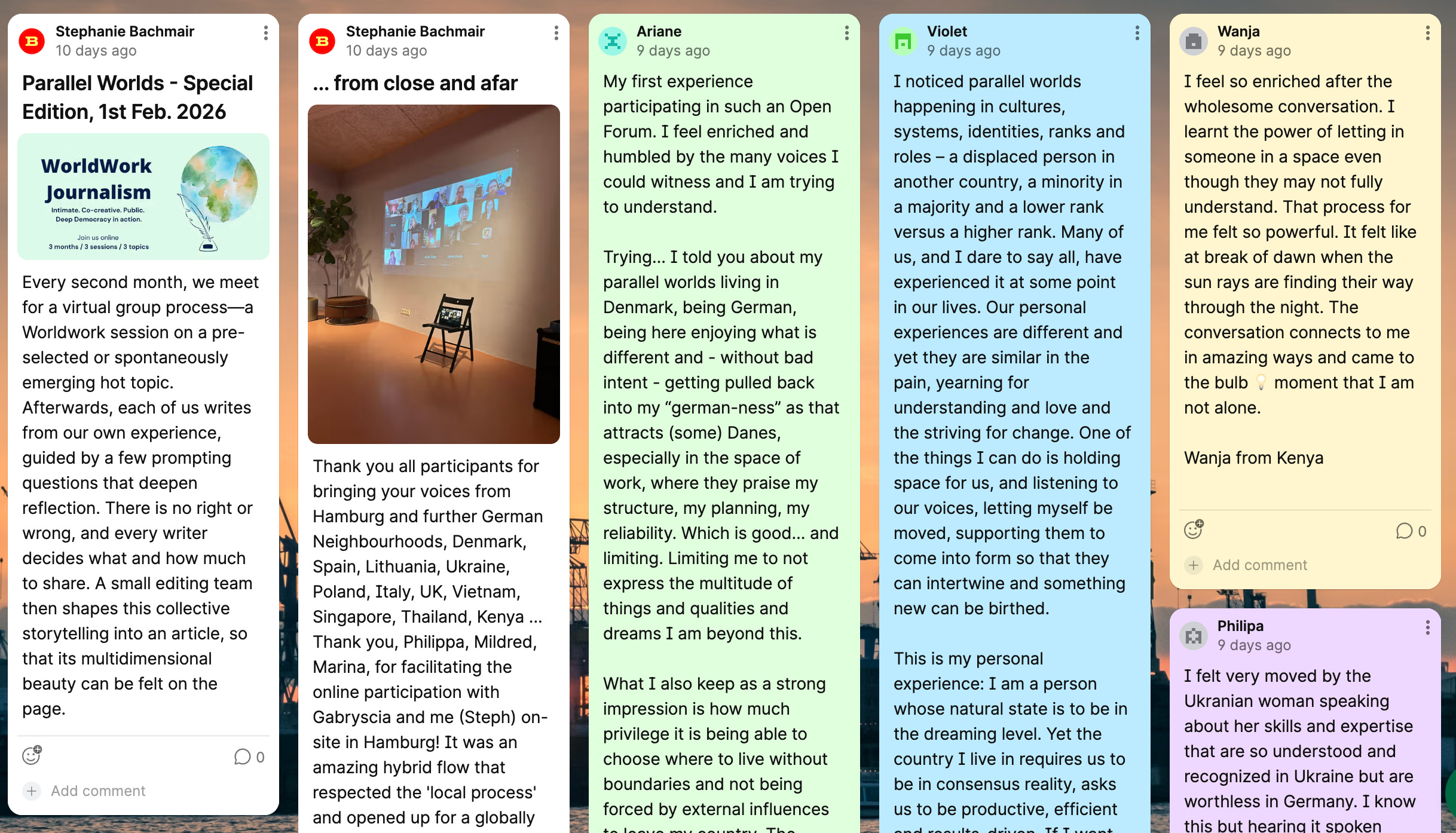
Link to padlet - with the original writings of some participants.
As a reader, you are also invited to share your perspective on the topics or delve deeper into the aspects discussed by participants, in the comments, here on Substack, below.
Thank you to all Worldwork Journalists involved in this conversation and sharing their personal experience.
We are looking forward to engaging with you in the comment section!
Apart from commenting below, we invite you to read and join the conversation here on Substack regularly by subscribing. We are grateful for every comment, as it enriches our conversations and supports this tender plant's growth.
About 🌏 Worldwork
Worldwork is an application of Processwork, also known as process-oriented psychology. As a psychological and conflict-resolution approach developed by Arnold Mindell in the 1970s, it's based on the principles of Jungian psychology, Taoism, and systems theory, and it is used in various settings, including therapy, organisational development, community building, and conflict resolution. At its core, Worldwork aims to explore and understand both individual and collective processes to address conflicts, promote personal growth, and create more harmonious relationships within groups and communities. It focuses on bringing awareness to marginalised or ignored perspectives, as well as the deeper layers of consciousness within individuals and groups.
Editors of this space
Cynthia Wanjihia is a passionate Process Work student as well as a Cyber Security student. She is open-minded in world work as well as inter-generational relationships, hoping to relate to all and create a safe space to feel heard and share their story.
Stephanie Bachmair (B.ONFIRE/DD Alliance) is a content creator, facilitator, leadership coach, and process work diplomat. She supports individuals, teams, and organisations in exploring and crafting their stories, telling them with impact, relating to their audience, and increasing their transformative power through dialogue and deep democracy facilitation.
If you want to engage further:
Conflict on Stage – Vilnius, Lithuania | 6–8 March
with Zbyszek Milunski and Stephanie Bachmair
Dream Lab – monthly virtual practice space
Every third Saturday, 8–10 am (CET)
If you want to get inspired and be informed about further Deep Democracy and Processwork happenings, you can also subscribe to our joint monthly newsletter.
For professional updates on leadership and facilitation: B.ONFIRE
For dialogical initiatives and social innovation projects: echoed.studio
Worldwork Journalism is an initiative of echoed.studio.

Thanks for reading Worldwork Journalism! Subscribe for free to receive new posts and support our work.
Thank you Stephanie for creating the space to explore the topic and participate in the co-creative process of one common peace!
Reading this again, I was back in that room. And in many parallel rooms simultaneously.
We spend so much energy trying to be understood. That evening shifted something. Maybe the point is not to be understood immediately. Maybe it's enough to be witnessed for a start.